


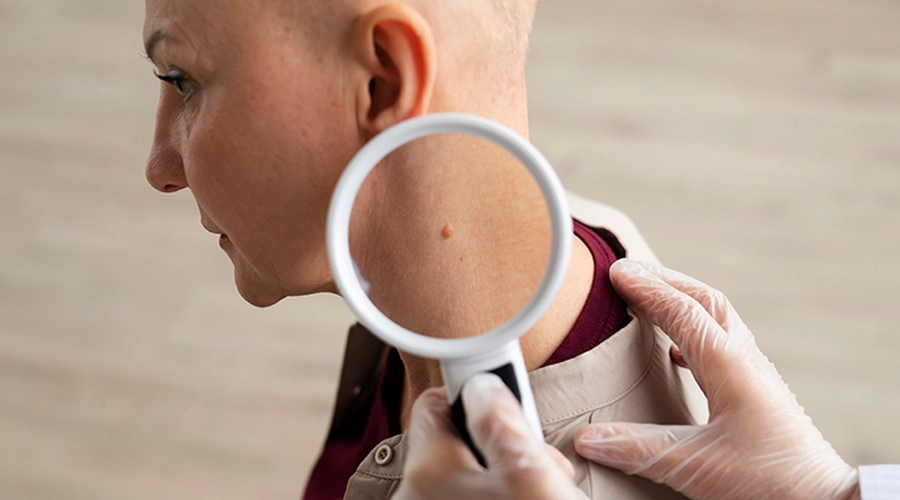
What is Skin Cancer Reconstruction?
Skin cancer reconstruction is a general term for reconstructive surgical procedures performed to repair tissue loss that occurs after surgical removal of skin cancer. Skin cancer reconstruction aims to safely close the wound, preserve the function of the affected area, and achieve as natural a appearance as possible.
Skin cancer surgeries may require the removal of a certain amount of healthy tissue surrounding the tumor. This can lead to tissue loss, particularly in areas such as the face, nose, eyelids, ears, and lips.
During reconstruction, methods such as direct sutures, skin grafting, or flaps can be used. The technique chosen depends on the size, depth, and location of the wound.
The priority is to treat the cancer appropriately. The reconstruction plan is prepared taking into account the characteristics of the tumor and an assessment of the surgical margins.
Why is skin cancer reconstruction performed?
Skin cancer reconstruction is performed to close the wound after removal of skin cancer, restore tissue integrity, and preserve the function of the affected area. Skin cancer reconstruction aims to achieve functional and aesthetic improvement, especially in areas where important anatomical structures are affected.
Tissue loss in areas such as the nose, eyelids, lips, and ears doesn’t just change appearance. It can also affect functions such as breathing, eye protection, or mouth movements.
The goal of reconstruction is to close the open wound and maintain the surrounding tissues in the appropriate position. However, achieving a completely scarless result or the exact same appearance as before is not possible in every patient.
In surgical planning, the safety of cancer treatment is paramount. Aesthetic goals must be considered alongside this fundamental requirement.
Who is a suitable candidate for skin cancer reconstruction surgery?
Individuals who have experienced tissue loss after skin cancer surgery that is not suitable for spontaneous healing or that may cause functional problems may be evaluated for reconstruction. Suitability for skin cancer reconstruction depends on the characteristics of the wound and the individual’s overall health.
Surgical repair may be necessary, especially in individuals with extensive tissue loss in the facial area. However, some small wounds in suitable locations can be left to heal spontaneously in a controlled manner.
Diabetes, smoking, circulatory problems, and diseases affecting the immune system can alter wound healing.
The type of tumor, the condition of the surgical margins, and the need for additional cancer treatment should also be evaluated. The timing and method of reconstruction are determined based on these findings.
How is tissue loss assessed after skin cancer surgery?
Tissue loss is assessed by examining the extent and depth of the wound and which anatomical structures are affected. In skin cancer reconstruction planning, not only the amount of missing skin but also the condition of the underlying tissues is important.
While some injuries involve only skin loss, in other cases structures such as fat tissue, cartilage, or muscle may also be affected.
Even a small tissue deficiency, especially in areas like the nose and eyelids, can have significant functional consequences. Therefore, tissue mobility and blood circulation around the wound are evaluated.
The repair method is chosen according to the characteristics of the existing tissue loss. While direct closure may be sufficient in some patients, grafts or flaps may be required in more complex wounds.
Why is the location of the tumor important in reconstruction planning?
The location of the tumor determines the functional and aesthetic effects of tissue loss that will occur after surgery. In skin cancer reconstruction planning, anatomical areas such as the nose, eyelids, lips, and ears require special attention.
Tissue loss in the nasal area can affect airway patency and nasal contour. Similarly, eyelid loss can make it more difficult to protect the eye’s surface.
In wounds around the lips, mouth closure and movements are important. In ear wounds, preserving the cartilage support may be necessary.
Therefore, two wounds of the same size may require different reconstruction methods in different areas. Planning should preserve not only the appearance but also the function of the affected area.
How is the size of the defect caused by skin cancer determined?
The size of the defect is determined by measuring the length, width, and depth of the wound created after tumor removal. In skin cancer reconstruction planning, these measurements help in selecting the appropriate closure method.
Not only the surface area of the wound is assessed, but also the extent to which the underlying tissues are affected. Loss of cartilage, muscle, or other supporting structures can alter the scope of repair.
In cases where additional tissue needs to be removed to confirm clean surgical margins, the defect may enlarge. Therefore, the final wound size may sometimes be larger than the apparent size of the tumor.
The reconstruction plan is finalized after definitive tissue loss has occurred. This approach is particularly important in Mohs surgery.
How is skin cancer reconstruction surgery performed?
The surgery is performed by selecting the appropriate repair method according to the extent and location of the tissue loss. During skin cancer reconstruction, direct suturing, skin grafting, or flap techniques can be used.
Small, conveniently located wounds can be closed by bringing the surrounding tissues closer together. For larger superficial losses, a skin graft taken from another area of the body can be used.
In the flap method, tissue transferred from an adjacent or distant area is moved to the wound site while preserving blood circulation or re-establishing vascular connections.
Some complex reconstructions may require multiple surgical stages. When determining the appropriate technique, the safety of the cancer treatment, tissue circulation, and the function of the affected area are primarily evaluated.
How long does reconstructive surgery take?
The duration of reconstructive surgery varies depending on the size of the wound, its location, and the surgical technique used. In skin cancer reconstruction, a simple wound closure will not be completed in the same amount of time as a complex flap repair.
For limited skin loss, shorter procedures may suffice. Surgery time may be longer for extensive tissue deficiencies or when multiple anatomical structures need to be repaired.
In some patients, tumor removal and reconstruction can be performed in the same procedure. In other cases, it may be necessary to wait for the surgical margins to be finalized.
Therefore, there is no fixed surgery duration that applies to all patients. The duration is assessed after the definitive surgical plan has been established.
Which type of anesthesia is used in skin cancer reconstruction?
Local anesthesia, sedation, or general anesthesia may be used during reconstruction. The choice of anesthesia for skin cancer reconstruction depends on the size of the wound, its location, and the surgical technique to be used.
Repairing small and limited wounds can be performed under local anesthesia in some patients. General anesthesia may be required for more extensive or complex reconstructions.
The patient’s age, overall health status, and any underlying medical conditions also influence the anesthesia plan.
Anesthesia selection is not based solely on the duration of the procedure. Surgical safety, patient comfort, and any procedures that may be necessary during the operation should all be considered together.
Is a hospital stay necessary after reconstruction surgery?
The need for hospitalization depends on the reconstruction method used and the patient’s overall health condition. Some patients who undergo minor repairs after skin cancer reconstruction can be discharged the same day.
Hospitalization may be required for larger flap surgeries or in cases where close monitoring of tissue circulation is necessary.
Monitoring blood flow to the flap is crucial, especially in complex surgeries involving free tissue transfer. Comorbidities can also affect the follow-up period.
The decision to discharge a patient is not based solely on the completion of surgery. Wound condition, pain control, and necessary care should be evaluated together.
What are the first few days like after skin cancer reconstruction surgery?
In the first few days after surgery, swelling, bruising, tenderness, and tightness may be observed around the wound. The healing process after skin cancer reconstruction depends on the repair method used and the location of the wound.
Maintaining tissue circulation is particularly important in patients undergoing skin grafting or flap procedures. Therefore, dressings and movement restrictions must be applied as recommended.
In some areas, excessive stretching or pressure can negatively affect wound healing. Therefore, follow-up examinations are important.
Medical evaluation is necessary if you experience symptoms such as increasing pain, foul-smelling discharge, fever, noticeable discoloration, or rapidly developing swelling.
How long does swelling last after reconstruction?
Postoperative swelling is usually noticeable in the first few days and may gradually decrease in the following weeks. The duration of edema after skin cancer reconstruction depends on the location of the wound and the surgical technique used.
In facial reconstruction treatments, swelling can be more pronounced, especially in areas with loose tissue, such as around the eyes.
In large flap surgeries, it may take longer for the tissues to fully settle and for the final contour to emerge. Therefore, the early appearance may not reflect the final result.
However, if rapidly increasing swelling, severe pain, or discoloration of the flap develops, urgent evaluation for circulatory problems or blood accumulation may be necessary.
When does bruising after reconstruction surgery disappear?
Postoperative bruising usually appears in the first few days and fades over time, changing color. The duration of bruising after skin cancer reconstruction depends on the extent of the procedure and the individual’s healing characteristics.
Bruises may be more pronounced, especially after repairs to the face and around the eyes. In most patients, they may significantly lessen within a few weeks.
However, the time it takes for bruises to completely disappear varies from person to person. Medications and underlying health conditions can also affect this process.
A rapidly spreading bruise, especially if accompanied by significant tension or severe pain, should be medically evaluated for hematoma.
Skin Cancer Reconstruction Prices 2026
The cost of surgery varies depending on the extent of tissue loss, the anatomical location, and the reconstruction technique used. Therefore, there is no standard price for skin cancer reconstruction surgery in 2026 that can be applied to all patients.
Frequently Asked Questions
How is the cavity left after skin cancer removal closed?
After skin cancer is removed, the resulting wound can be closed using direct sutures, skin grafting, or flap methods, depending on its size and location. Skin cancer reconstruction planning assesses the depth of tissue loss and the mobility of surrounding tissues.
Is reconstruction necessary after skin cancer surgery?
Reconstructive surgery is not mandatory after every skin cancer operation. The need for reconstruction after skin cancer depends on the size, depth, and location of the wound.
Can reconstruction be done on the same day?
In suitable patients, skin cancer removal and reconstruction can be performed on the same day. The timing of skin cancer reconstruction depends on the characteristics of the tumor and the method used to evaluate surgical margins.
When is reconstruction performed after Mohs surgery?
Reconstruction after Mohs surgery can be planned once it has been microscopically confirmed that the tumor has been completely removed. Skin cancer reconstruction can be performed on the same day in many patients.
Which gives better results: skin graft or flap?
Skin grafting and flaps are methods used for different types of tissue loss; neither is superior to the other in every case. In skin cancer reconstruction planning, the depth, location, and tissue circulation of the wound are evaluated.
Will there be scarring after skin cancer on the nose?
Permanent scarring can occur after skin cancer surgery in the nasal area. While skin cancer reconstruction aims to reduce the visibility of the scar, a completely scarless recovery cannot be guaranteed.
Can the appearance of skin on the face completely improve after skin cancer?
Facial tissue loss can be significantly corrected with reconstructive methods, but a complete restoration of the pre-operative appearance is not always possible. During skin cancer reconstruction, the goal is to preserve natural facial features and functions.
If the skin graft doesn’t take, will another surgery be necessary?
If the skin graft does not receive adequate blood circulation, partial or complete graft loss may occur. In such a case after skin cancer reconstruction, the treatment to be applied depends on the extent of tissue loss.
Is tissue loss possible after flap surgery?
If circulatory problems develop after flap surgery, partial or complete tissue loss may occur. Therefore, preserving the blood supply to the flap is important during skin cancer reconstruction.
How long does it take for a wound to heal after reconstruction?
The healing time of the wound depends on the method used, the extent of tissue loss, and the individual’s health condition. After skin cancer reconstruction, superficial wound closure can occur within a few weeks, but tissue maturation may take longer. Healing characteristics differ in skin graft and flap surgeries. It may take months for scars to soften and for the final appearance to emerge. Infection or circulatory problems can delay healing.