


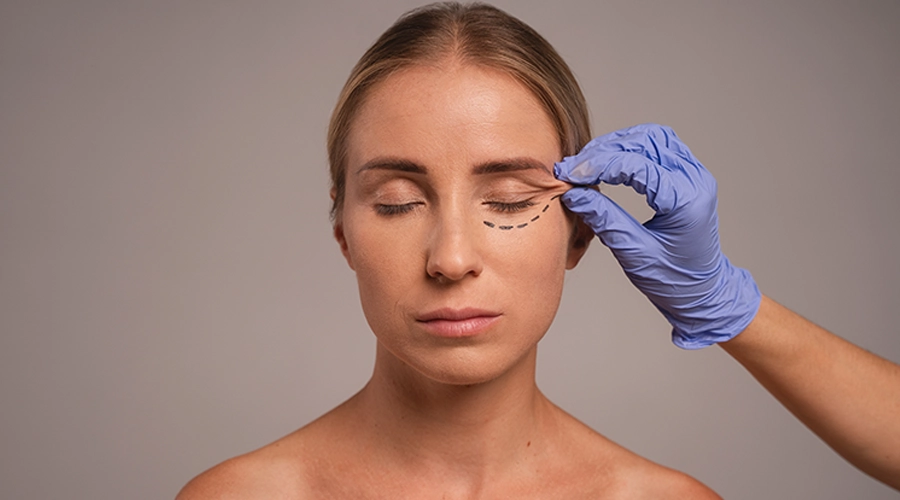
What is Eyelid Surgery?
This is a surgical procedure aimed at correcting excess skin, prominent fatty tissue, and certain contour irregularities in the upper and lower eyelids. Also called blepharoplasty, eyelid surgery aims to create a more balanced appearance while preserving the natural structure of the eye area.
In upper eyelid surgery, excess skin is usually removed, and if necessary, a certain amount of fat tissue is altered. In the lower eyelid, puffiness, skin laxity, and irregularities in the under-eye contour can be evaluated.
The scope of the surgery varies depending on the individual’s anatomy. Not every patient requires intervention on both the upper and lower eyelids.
In surgical planning, eyelid closure function, tear film, and eyelid support are important. Removing too much tissue can lead to dryness, difficulty closing, or distortion of eyelid position.
What is the goal of eyelid aesthetics?
The primary goal is to reduce excess skin accumulation and noticeable contour irregularities around the eyes while preserving the natural function of the eyelids. Personalized eyelid surgery can create a more rested appearance and, in suitable patients, reduce visual field limitations caused by excess skin on the upper eyelid.
Removing excess skin from the upper eyelid can make the eyelid crease appear more pronounced. In the lower eyelid, reducing puffiness or repositioning fat tissue can be considered.
However, not all signs of aging around the eyes can be corrected with blepharoplasty. Drooping eyebrows, true eyelid drooping, and fine wrinkles in the skin may require different treatments.
The goal is not to enlarge the eyes as much as possible, but to preserve their natural appearance and eyelid function.
How does aging around the eyes change facial expression?
Aging around the eyes can affect facial expression through skin laxity, increased fat deposits, and changes in eyebrow position. In this process, eyelid surgery can be considered, particularly to reduce the tired appearance caused by excess skin and puffiness around the eyelids.
Skin buildup on the upper eyelid can make the eyes appear heavier or closed. Bags under the lower eyelid, on the other hand, can create shadows around the eyes, increasing the appearance of fatigue.
Downward displacement of the eyebrows can also accentuate fullness in the upper eyelid. This should not be confused with laxity caused solely by the eyelid skin.
The signs of aging do not develop the same way in everyone. Skin quality, bone structure, and genetic factors all affect the appearance of the skin around the eyes.
What causes skin folds on the eyelids?
Skin accumulation under the eyelids mostly develops with aging as a result of decreased skin elasticity and changes in supporting tissues. In cases of significant excess skin, Eyelid Aesthetics can be considered to remove an appropriate amount of tissue.
Loose skin on the upper eyelid can bunch up over the natural crease. In some people, this can extend to the lash line, making the eye appear more closed.
Drooping eyebrows can also create the appearance of skin accumulation on the upper eyelid. Therefore, the position of the eyelid skin and the eyebrow should be evaluated separately.
Genetic factors and skin structure are also important. Not all excess skin requires surgery; the decision to proceed should be made by considering appearance, function, and the individual’s overall eye health.
How Does Fat Tissue Around the Eyes Change Over Time?
The fatty tissue around the eyes can change in volume and location during the aging process. In particular, the weakening of the supporting structures around the eye socket can cause some fat pads to appear more prominent. In these cases, eyelid surgery may involve the controlled reshaping of this fatty tissue.
Under-eye bags aren’t always caused by an increase in fat. A combination of fat protruding forward and loss of volume in the surrounding area can contribute to the problem.
In the upper eyelid, some areas may show increased fullness while other areas may show hollowness. Therefore, focusing solely on fat removal is not the correct approach.
Removing too much fat can create a sunken and aged appearance around the eyes. Preserving or repositioning the fat may be more suitable for some patients.
How to Correct the Appearance of Heavy Eyelids?
A heavy appearance of the upper eyelid may be related to excess skin, drooping eyebrows, or changes in the function of the muscle that lifts the eyelid. If excess skin is the underlying problem, Eyelid Aesthetics can provide a more open appearance by removing this tissue in a controlled manner.
However, true eyelid drooping, or ptosis, is when the eyelid margin is lower than normal. In this case, simply removing the skin may not be sufficient, and a procedure targeting the mechanism that lifts the eyelid may be necessary.
Drooping eyebrows can also cause a feeling of heaviness in the upper eyelid. If the source of the problem is the eyebrow position, a different surgical approach may be considered.
The priority in the treatment plan is to ensure the eye closes completely and to protect the corneal surface. Removing too much skin can lead to functional problems.
What causes loss of upper eyelid crease?
The natural crease in the upper eyelid is formed by the relationships between the skin and the underlying anatomical structures. Aging, excess skin, and tissue changes can cause this line to appear less prominent. In suitable patients, eyelid surgery can help make the crease visible again.
Skin that accumulates on the upper eyelid can cover the natural fold. In some individuals, however, the fold may be less prominent from the start due to anatomical structure.
Previous surgeries and scar tissue can also alter the position of the fold. This requires careful evaluation, especially when it creates an asymmetrical appearance.
The goal during surgery is not to create a fold of the same height in everyone. The individual’s eyelid anatomy and natural facial features must be preserved.
How do under-eye fullness and bags form?
Under-eye bags are often associated with the protrusion of fat pads around the eye socket. In these cases, eyelid surgery may be planned to reduce or reposition the fat tissue.
With age, the supporting structures in the lower eyelid can change. The fatty tissue under the eyes may become more prominent, while volume loss can occur in the cheek area.
The transition between these two changes can make the bags appear larger than they are. However, not all under-eye fullness is fat bags.
Edema, allergies, and certain health problems can also cause swelling under the eyes. Therefore, it is important to distinguish between permanent anatomical puffiness and temporary swelling.
Can sunken and baggy under-eye areas be corrected together?
Under-eye bags and hollowness can coexist in the same person. In such cases, Eyelid Surgery can focus on regulating the transition between the under-eye area and the cheek, rather than simply removing fatty tissue.
The sunken area beneath the baggage can make the fat bulge more prominent. Therefore, simply reducing the baggage doesn’t always provide a balanced result.
In suitable patients, repositioning of existing fat tissue may be considered. Some individuals may require additional procedures to address volume deficiency.
The goal is not to completely flatten the under-eye area. The natural contour of the eye area should be preserved, and excessive fat removal that creates a sunken appearance should be avoided.
How to assess asymmetry around the eyes?
Asymmetry around the eyes can result from differences in upper eyelid crease, skin volume, eyebrow position, or lower eyelid contour. In eyelid aesthetic surgery planning, these differences are assessed by identifying the anatomical structure causing them.
The two eyelids are not expected to be exactly the same. Natural facial asymmetry, the position of the eye socket bones, and the position of the eyebrows can affect the appearance.
The height of the eyelid margin is also important. The presence of true ptosis in one eye cannot be interpreted as simply having excess skin.
Previous surgeries and scar tissue can also create asymmetry. The surgical goal is not perfect equality, but rather a balanced and functional outcome as much as possible.
How to Determine the Right Time for Eyelid Surgery?
The timing of surgery is determined not by age, but by anatomical changes in the eyelids and the individual’s needs. Eyelid surgery can be considered for individuals with significant excess skin or puffiness, provided their overall health and eye surface conditions are suitable.
In some people, due to genetic factors, under-eye bags may become prominent at a young age. In others, no changes requiring surgery may occur until later in life.
Dry eyes, thyroid eye disease, and previous eye surgeries can affect planning. Additional evaluation may be required in these cases.
The decision for surgery should not be made hastily. It should be determined whether the complaint is persistent and whether there is an underlying eyelid problem requiring different treatments.
How are eyelid measurements taken before blepharoplasty?
Before surgery, eyelid height, crease position, excess skin, and eyelid closure function are assessed. These measurements help determine which tissues can be safely adjusted during eyelid surgery.
The location of the natural crease in the upper eyelid and the position of the eyelid margin relative to the pupil can be examined. This allows for an assessment of the difference between excess skin and true ptosis.
Lower eyelid laxity, eyelid support, and its relationship with the eyeball are important. If necessary, the horizontal tension of the eyelids and the eye’s closing capacity are assessed.
Tear film and eye surface health should also be considered. The purpose of the measurements is not only to determine aesthetic proportions but also to ensure the preservation of eye functions after surgery.
How Does Eyelid Skin Quality Affect Surgical Planning?
The skin of the eyelids is thin and delicate, differing from other areas of the face. Therefore, in planning eyelid aesthetics, skin thickness, elasticity, laxity, and wound healing characteristics are evaluated.
Thin and loose skin can cause folding in the upper eyelid. In the lower eyelid, skin quality and the condition of supporting tissues can affect the postoperative eyelid position.
Removing too much skin can make it difficult for the upper eyelid to close completely. Removing too much tissue from the lower eyelid can cause it to pull down.
Previous surgeries, dry eye, and certain skin conditions can alter the surgical plan. The goal of surgery is to reduce excess tissue while preserving the surface of the eye.
Can scar asymmetry after eyelid surgery be corrected?
The difference in the appearance of scars on the two eyelids after surgery may be related to wound healing, incision location, or natural anatomical asymmetry. In cases of persistent and significant problems, revision options after eyelid surgery may be considered.
Early redness, hardness, and swelling can cause scars to look different. Because scars take time to mature, early assessment can be misleading.
The cause of scar asymmetry may not be solely the skin surface. The height of the fold or the position of the underlying tissues can also affect the appearance.
When preparing a revision plan, the existing amount of skin and the function of the eye closing should be preserved. Not every scar difference can be completely eliminated surgically.
What are the options after too much or too little tissue is taken?
Removing too much or too little tissue during a previous eyelid surgery can lead to aesthetic and functional problems. In these cases, eyelid revision surgery is planned according to the type of existing problem.
Insufficient skin removal can create a persistent fold or heaviness appearance in the upper eyelid. However, this should not be confused with brow ptosis or true ptosis.
Removing too much skin can make it difficult for the eye to close completely. Removing excessive tissue from the lower eyelid can disrupt eyelid position and leave the eye surface exposed.
In these types of problems, simply removing the skin is not appropriate. Some patients may require tissue support, grafting, or procedures to correct the eyelid position. Inability to close the eye, significant pain, or changes in vision require rapid evaluation.
How is revision blepharoplasty planned?
In revision eyelid surgery, a new surgical plan is prepared by evaluating the amount of skin available and eyelid function in previously operated eyelids. Previous incision sites, scar tissue, and the position of the eyelids are particularly important in revision eyelid surgery.
Reasons for revision may include persistent excess skin, fold asymmetry, significant bagging, or misalignment of the flap. However, not every problem can be corrected with the same method.
If excess tissue was removed in a previous surgery, supportive or reconstructive procedures may be necessary instead of removing tissue again.
Dry eyes, eyelid closure, and lower eyelid support must be evaluated. The timing of surgery is also determined according to the healing status of the tissues. The goal is to improve appearance while avoiding risking eye health.
Is it possible to have blepharoplasty again after a previous eyelid surgery?
Individuals who have previously undergone eyelid surgery may have a second procedure if the appropriate anatomical conditions are met. However, a repeat eyelid surgery may require different assessments than the first operation.
The amount of skin and fat removed in the previous surgery is important. Scar tissue, the position of the eyelid fold, and the eye’s closure function all influence new surgical options.
Skin laxity may recur over time. However, immediate re-operation may not be appropriate due to early swelling or temporary asymmetry.
The goal of the second surgery is not always to remove more skin. In some patients, it may be necessary to strengthen the flap support or correct previous contour changes.
Eyelid Surgery Prices 2026
The cost of surgery varies depending on whether the upper or lower eyelid is treated, the techniques used, and any additional surgical requirements. Therefore, there is no standard price for eyelid surgery in 2026 that can be applied to all patients.
Frequently Asked Questions
Can eyelid surgery reduce a tired facial expression?
Excess skin on the upper eyelid and bags under the lower eyelid can contribute to a more tired-looking face. For individuals with pronounced eyelid surgery, the eyelid aesthetics procedure can help the eye area look more rested.
However, a tired appearance isn’t solely due to the eyelids. Drooping brows, sunken under-eyes, and skin discoloration can also contribute. Therefore, the outcome depends on existing anatomical issues.
Can eyelid surgery make the eyes look more open?
Reducing excess skin on the upper eyelid can make the eyes appear more open. However, eyelid surgery does not alter the actual size of the eyeball.
If there is true drooping at the eyelid margin, skin removal alone may not be sufficient. In such cases, an assessment for ptosis is necessary. The surgical plan should be designed to preserve the eye’s natural closing function.
Does the eyelid crease change after blepharoplasty?
Altering the amount of skin on the upper eyelid can affect the appearance of the natural crease. Therefore, after eyelid surgery, the crease may become more prominent or appear in a different position.
The height of the fold depends on the existing anatomy and the technique used. Postoperative swelling can cause asymmetry in the early stages. Progression of the healing process is necessary before the permanent appearance can be assessed.
Does eyelid surgery also eliminate wrinkles around the eyes?
Removing excess skin from the eyelids can reduce the appearance of some wrinkles. However, eyelid surgery does not eliminate all fine lines and skin surface changes around the eyes.
Wrinkles, especially those caused by facial expressions, are due to different mechanisms. The main goal of surgery is to correct excess skin and pronounced contour problems.
Can crow’s feet be corrected with blepharoplasty?
Crow’s feet, which form at the outer corners of the eyes, are largely related to the movements of facial muscles and skin aging. Therefore, eyelid surgery is not a procedure that directly eliminates crow’s feet.
Reducing excess skin around the eyelids can alter the appearance of some lines. However, wrinkles that become more pronounced with movement may require different treatment options.
Can under-eye bags reappear?
Because the aging process continues after surgery, the appearance of the under-eye area can change again over time. Even after successful initial results from Eyelid Aesthetics, new bags or skin laxity may develop in later years.
The location of the fat tissue, skin quality, and genetic factors influence this process. However, the recurrence of bags under the eyes is not expected in every patient.
Should under-eye fat be completely removed?
Completely removing the fatty tissue under the eyes is generally not compatible with the goal of preserving the natural contour. During eyelid surgery, controlled reduction of excess fat or repositioning of existing fat may be considered.
Removing too much fat can create sunken areas and a skeletal appearance under the eyes. The appropriate method is determined according to the degree of puffiness and the distribution of volume in the surrounding area.
Can eyes appear different sizes after blepharoplasty?
Post-operative swelling and natural facial asymmetry can cause the eyes to appear temporarily different sizes. Differences in crease height or eyelid margins after eyelid surgery can also affect this perception.
The early signs do not necessarily mean a permanent outcome. However, if significant eyelid closure problems, severe pain, or changes in vision develop, prompt medical evaluation is necessary.