


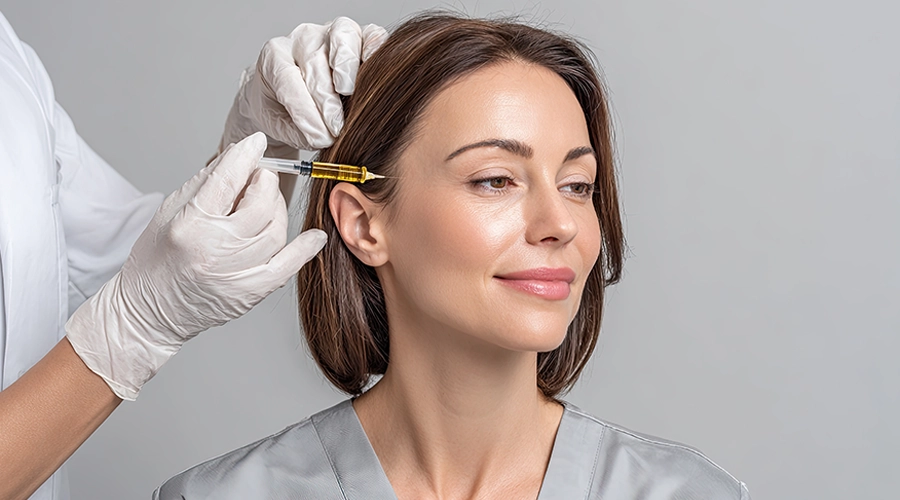
What is Facial Fat Injection?
Facial fat injection, also known as autologous fat transfer, involves taking fat tissue from the patient’s own body, processing it, and transferring it to areas of the face that have lost volume. It aims to reshape facial contours and reduce volume deficiency in specific areas.
During the procedure, fat is typically harvested from areas such as the abdomen, waist, or thighs. The harvested fat tissue is prepared using appropriate methods and injected in controlled amounts into the areas of the face where it is needed.
While some of the transferred fat cells can survive in the new area, others are absorbed by the body over time. Therefore, results vary from person to person.
The goal of the procedure is not to fill the face as much as possible. The aim is to balance the volume distribution while preserving natural facial proportions.
Why is facial fat injection performed?
One of the primary goals of the procedure is to reduce volume loss in the face caused by aging, genetic factors, or weight changes. In suitable patients, Facial Fat Injection can alleviate contour irregularities by adding volume to specific areas of the face.
Especially in the cheeks, temples, and certain facial transitions, hollowing can occur over time. This can make the face look more tired or less voluminous.
Fat transfer is not only used for age-related changes. Congenital volume differences or certain asymmetries may also be reasons for evaluation.
However, in individuals with significant skin sagging, simply adding volume may not be sufficient. Therefore, volume loss and tissue laxity should be distinguished from each other before the procedure.
Who is a suitable candidate for facial fat injection?
Individuals with significant facial volume loss, localized depressions, or contour differences that can be corrected with appropriate methods may be considered for the procedure. In adults with suitable general health, facial fat injection can be planned according to individual anatomical needs.
The procedure requires the availability of sufficient fat tissue from the body for harvesting. However, the presence of an area from which fat can be taken does not, by itself, guarantee suitability.
The existing fat distribution in the face, skin quality, and the degree of tissue sagging are important factors. In individuals with significant laxity, simply adding volume may not provide the desired result.
Smoking habits, circulatory problems, previous facial procedures, and overall health should also be considered. It’s important to have realistic expectations that not all of the transferred fat will be permanent.
Which areas can be treated with facial fat injection?
Fat transfer can be applied to reduce volume deficiency in different areas of the face. Suitable areas for facial fat injection are determined according to the individual’s anatomy, skin type, and the desired contour change.
The cheeks, cheekbone area, and temples are among the most frequently assessed areas. In some individuals, minor volume deficiencies in the jawline or lower face may also be addressed.
In areas with thin and sensitive skin, such as under the eyes, a more careful assessment is needed. Irregularities, swelling, or unwanted contour changes may be more visible in these areas.
Not every facial area is suitable for the same amount of fat transfer. The injection plane and amount should be determined taking into account vascular anatomy and the characteristics of surrounding tissues.
Why does volume loss occur?
Facial volume loss can be associated with aging, weight changes, genetic factors, and differences in the distribution of fat tissue. When these changes become pronounced, Facial Fat Injection may be considered to restore some of the lost volume.
With age, the amount and location of facial fat tissue can change. This can lead to sunken temples, decreased cheek volume, and more pronounced facial transitions.
Significant weight loss can also cause the face to appear less voluminous. However, not all hollowing is solely due to a decrease in fat tissue.
Age-related changes in bone structure and decreased skin elasticity also affect facial contour. Therefore, focusing solely on increasing volume should be avoided without first determining the cause of volume loss.
What problems can be corrected with facial fat injection?
Localized volume deficiencies in the face, certain contour irregularities, and asymmetries in suitable anatomical conditions can be reduced with fat transfer. Facial fat injection aims to create a more balanced volume distribution, especially in areas that appear sunken.
Prominent sunken temples, decreased cheek volume, and soft tissue deficiencies in certain areas of the face may be reasons for evaluation.
However, the procedure does not directly eliminate significant skin sagging. It also cannot guarantee complete correction of deep wrinkles or all facial asymmetries.
The volume gained may vary because some of the transferred fat can be absorbed over time. Therefore, both the initial anatomy and the biological behavior of the fat tissue should be considered in the treatment plan.
How Does Facial Fat Injection Rejuvenate the Face?
Restoring facial volume to specific areas that decrease with age can help create a more balanced facial contour. Facial fat injection, in particular, can reduce hollowness in areas like the cheeks and temples, creating a fuller appearance.
Volume loss in the face can make some shadows and transition lines more prominent. Appropriate fat transfer can soften contour differences in these areas.
However, facial aging isn’t solely about volume loss. Skin laxity, changes in muscle structure, and bone support are also important factors.
Therefore, fat injection is not a substitute for facelift surgery. Individuals with significant sagging may require different treatment options.
How are facial contours shaped with facial fat injection?
Facial contouring can be achieved by transferring controlled amounts of fat tissue to areas lacking volume. Facial fat injections aim to improve contour balance, particularly in the cheeks, temples, and certain facial transition areas.
Lack of volume in the cheek area can make the face appear flatter. Hollowing at the temples can also affect the upper facial contour.
During fat transfer, the overall proportions of the face must be taken into consideration. Adding excessive volume to one area may create disharmony with other facial features.
Also, since not all of the transferred fat is permanent, results may change over time. The goal is not to create a specific face shape, but to provide a volume distribution that is appropriate to the person’s natural anatomy.
How is a facial analysis performed before facial fat injection?
Pre-procedure facial analysis is performed to identify areas of volume loss and determine the impact of these changes on facial proportions. In planning facial fat injection, the face is evaluated from the front, side, and various other angles.
The fullness of the cheeks, the contour of the temples, and the differences between the left and right sides of the face can be examined. Skin elasticity and any existing tissue sagging are also included in the assessment.
It is important to distinguish between volume loss and skin laxity, because simply adding fat to an area with excess skin does not always yield balanced results.
Previous filler injections, fat transfers, and facial surgeries can also affect the planning. The goal is to add the appropriate amount of volume to the necessary areas.
Where can I get the fat for facial fat injections?
Fat tissue is usually taken from areas of the body where sufficient fat reserves are already present. For facial fat injection, areas such as the abdomen, waist, or thighs may be considered.
The area from which fat is to be harvested is determined according to the individual’s body structure and existing fat distribution. It is not necessary to harvest fat from the same area in every patient.
During the procedure, fat tissue is harvested using appropriate methods and prepared for transfer. It is important to protect surrounding tissues during fat harvesting.
The amount of fat needed for facial contouring is often different from that required for extensive body contouring procedures. Therefore, a significant reduction in fat in the donor area should not always be expected. Temporary swelling, bruising, and tenderness may occur in the donor area.
Which is more permanent: fat injection or hyaluronic acid filler?
The two methods have different characteristics in terms of permanence. While fat cells transferred during facial fat injection remain alive in the new area and can stay there for a long time, hyaluronic acid fillers are broken down by the body over time.
However, not all of the transferred fat is permanent. Some may be absorbed during the healing process, and the remaining amount can vary from person to person.
The longevity of hyaluronic acid fillers depends on the product’s properties, the application area, and individual factors. Additionally, in appropriate cases, they may be dissolved with hyaluronidase.
Both methods carry risks. Injecting unwanted substances into a vein can cause serious tissue damage and, rarely, severe complications such as vision loss. Therefore, the choice of method should not be based solely on permanence.
Can facial fat injection and facelift be performed together?
When there is both significant tissue sagging and volume loss in the face, the two procedures can be considered together. Facial fat injection can be planned to support the missing volume as well as the tissues repositioned during a facelift.
A facelift primarily focuses on reshaping sagging tissues. Fat transfer, on the other hand, aims to create volume in sunken areas.
Therefore, the two procedures address different anatomical issues. However, fat transfer is not necessary for every facelift patient.
The combination of procedures may affect the duration of the surgery and the recovery process. The decision should be made after evaluating the patient’s overall health, facial anatomy, and the scope of the surgery.
Can facial fat injection be combined with eyelid aesthetics?
When there is both excess eyelid skin and significant volume loss around the eyes, procedures can be considered together. Facial fat injection can be planned in suitable patients to reduce depressions in the surrounding tissues in addition to eyelid aesthetics.
Blepharoplasty focuses on removing excess skin and prominent fat pockets. Fat transfer, on the other hand, aims to support areas where there is a lack of volume.
However, the skin around the eyes is thin and delicate. Fat transfer in this area requires careful planning due to the risk of irregularities, prolonged swelling, and other complications.
Not all under-eye hollows are suitable for fat injection. Eyelid support, skin quality, and eye surface health should be evaluated together.
Can facial fat injection and brow lifting be done simultaneously?
When there is both eyebrow drooping and volume loss around the temples or forehead in the upper facial area, procedures can be planned together. Facial fat injection can be considered to reduce some volume deficiencies that eyebrow lifting does not address.
Brow lifting aims to reshape the position of the brows and the surrounding supporting tissues. Fat transfer, on the other hand, adds volume to specific areas.
These two procedures are not interchangeable. In a person with drooping eyebrows, fat injection alone may not sufficiently alter the anatomical position of the eyebrows.
The decision to proceed should be made jointly, taking into account the anatomy of the eye area, surgical duration, and healing risks.
Can facial fat injection and neck lift be performed together?
In individuals with facial volume loss and significant sagging in the neck, both procedures can be considered within the same surgical plan. Facial fat injection aims to add volume to sunken areas of the face, while a neck lift focuses on reshaping loose tissues in the neck.
These procedures address different anatomical issues. A neck lift can reduce skin and muscle laxity under the chin, but it does not directly correct volume loss in the upper or middle areas of the face.
Fat transfer is also not a treatment that replaces significant neck sagging.
The scope of the surgery and the recovery process may change if they are performed together. It may not be suitable to perform both procedures in the same session for every patient.
Can facial fat injection and rhinoplasty be performed together?
In individuals with nasal deformities and volume deficiency in specific areas of the face, both procedures can be considered within the same surgical plan. Unlike rhinoplasty, facial fat injection aims to regulate the soft tissue volume of the face, not the bone and cartilage structure of the nose.
Rhinoplasty deals with the shape of the nose and, where necessary, its functional structures. Fat transfer, on the other hand, can reduce volume deficiency in areas such as the cheeks or temples.
Performing both procedures together requires a holistic assessment of the facial profile. However, not everyone who undergoes rhinoplasty needs fat transfer.
Surgical duration, swelling, and healing conditions must be considered together. The decision should be made based on the individual’s overall health and the scope of the planned procedures.
Can facial fat injections and laser treatments be combined?
When there is both volume loss and skin surface problems in the face, different treatments can be evaluated together or in stages. Facial fat injections focus on reducing volume deficiency, while laser treatments can target the skin surface or specific skin layers depending on the chosen technology.
However, not all laser treatments are applied at the same depth or have the same healing time. Ablation lasers, in particular, create controlled damage to the skin and a controlled healing process.
The suitability of performing laser treatment in the same session as fat transfer depends on the characteristics of the laser used, the treatment areas, and the tissue condition.
It is not necessary for both procedures to be performed simultaneously. Timing should be determined by evaluating skin health, risk of infection, and healing requirements.
Facial Fat Injection Prices 2026
The cost of the procedure varies depending on the areas to be treated with fat transfer, the amount of fat required, and the scope of the surgery. Therefore, there is no standard price for facial fat injection in 2026 that can be applied to all patients.
Frequently Asked Questions
Is facial fat injection permanent?
Some of the transferred fat cells may survive and remain in the new area for a long time. However, not all fat cells are expected to remain permanently after facial fat injection.
Some fat may be absorbed during the recovery period. The remaining fat tissue can also be affected by weight changes and aging in later years. Therefore, it cannot be guaranteed that the results will remain completely unchanged.
How much of the fat injected into the face will last?
The survival rate of fat cells varies depending on individual tissue characteristics, the application area, and the techniques used. Therefore, there is no guaranteed success rate for facial fat injection that can be applied to everyone.
Some of the transferred fat may be absorbed over time. Initial swelling can also make it difficult to assess the true volume loss. Permanent volume changes become clearer as healing progresses.
How long does facial fat injection take?
The procedure time depends on the area from which the fat is being harvested, the preparation stage, and how many areas of the face will be treated. A limited application and a comprehensive facial fat injection may not be completed in the same amount of time.
The performance of additional surgical procedures can also affect the total duration. Therefore, it is not accurate to give a fixed procedure time that applies to everyone.
Is facial fat injection painful?
Pain is controlled during the procedure using an appropriate anesthesia method. After facial fat injection, tenderness, swelling, and mild pain may occur both in the area where the fat is taken and in the areas of the face where it is applied.
The degree of discomfort depends on the scope of the treatment and individual recovery. Severe and progressively worsening pain, significant color changes, or vision problems require immediate evaluation.
How many days does swelling occur after facial fat injection?
Swelling is usually noticeable in the early post-procedure period and subsides over time. The duration of edema after facial fat injection depends on the areas treated, the amount of fat transferred, and individual recovery.
Even after the initial swelling subsides, mild edema may persist for a while longer. The fullness seen in the first few days does not directly indicate the final fat volume.
When does the face return to normal after facial fat injection?
The face begins to look more natural as swelling decreases and the transferred fat tissue heals. In the early stages after facial fat injection, some areas may temporarily appear fuller.
The assessment of the lasting volume result does not coincide with the return to social life. The appearance may change over months due to the absorption of some of the fat tissue.
How many days does bruising last after facial fat injection?
Bruising may occur in the area from which fat is harvested and in the injection areas of the face. The amount and duration of bruising after facial fat injection depend on the scope of the procedure, tissue characteristics, and individual healing.
Bruises usually fade over time and change color, but they don’t completely disappear on the same day for everyone. Bleeding tendencies and medications can also affect the appearance of bruises.